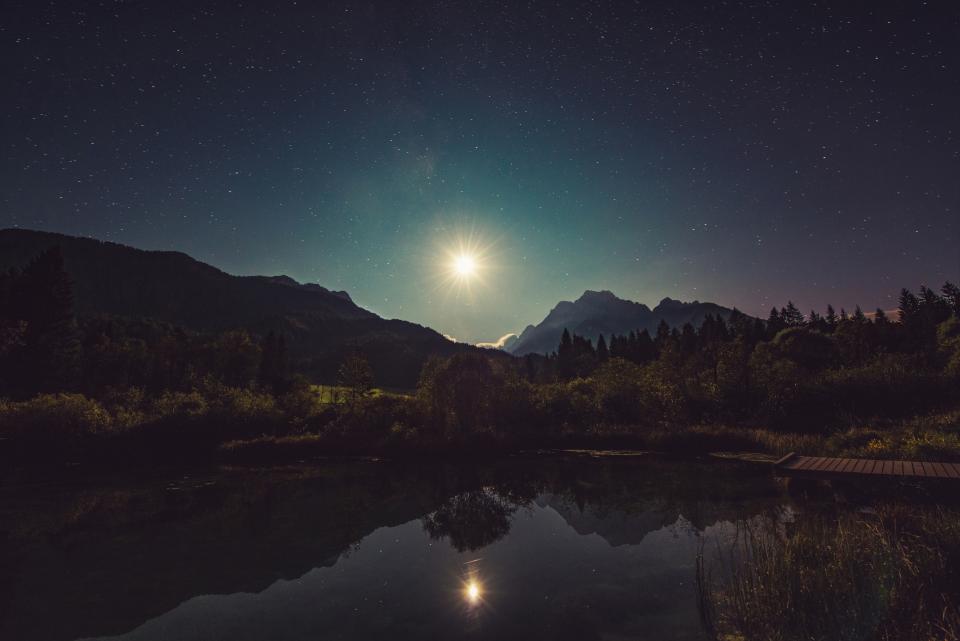
What Happens When the Light Goes Out of the Cove
Dark arrives early in a cove. The sun drops behind the west ridge well before actual sunset, and for an hour the hollow sits in blue shadow while the ridge tops are still lit. Then the cold air starts sliding downhill, the creek gets louder, and the woods hand the evening over to a completely different set of animals.
Guests who have only ever slept in town are usually startled by two things: how dark it gets, and how much noise darkness makes. Neither is a problem. Both are the reason to be here.
Why a Cove Sounds the Way It Does
Some of what you hear at night is simply better acoustics. After sundown the air near the ground cools faster than the air above it, and that temperature inversion bends sound waves back down toward you instead of letting them escape upward. A dog barking two ridges over can sound like it is in the yard.
The landform helps too. Slopes on both sides act like a shell, reflecting sound down the hollow, and there is no traffic hum to mask anything. The creek provides a constant floor of white noise that your ear stops hearing after ten minutes, so everything else stands out against it.
The Voices You Will Hear
Owls
The barred owl is the one you will hear most in wooded coves like this. Its call is the familiar cadence people write as who cooks for you, who cooks for you all, and a pair can carry on a long, escalating exchange of hoots, caws and screams that sounds less like an owl than like an argument. It is entirely normal.
The eastern screech-owl does not screech. It makes a descending whinny or a long even trill, small and eerie, usually from lower woods and edges. Great horned owls give deeper, more spaced hoots and favor open ground and ridge edges. Learning these three covers most owl nights here.
Whip-poor-wills
If you hear a bird chanting its own name over and over from the woods edge on a late spring or summer night, that is an eastern whip-poor-will. They call most persistently in the hours around dusk and dawn and often ramp up on bright moonlit nights, when they hunt moths by moonlight. Related nightjars, including the chuck-will’s-widow, occur at lower elevations to the south and east, with a slower, huskier phrase. Whip-poor-wills have declined across much of their range as insect populations and open-woodland habitat have changed, so hearing one is less common than it was a generation ago and worth stopping to listen to.
Coyotes
Coyotes are not original residents of these mountains; they expanded across the East over the last century and are now everywhere. What you will hear is a group yip-howl, a rising tangle of howls and high yips that starts abruptly and ends the same way. It carries an enormous distance and it makes two animals sound like ten, which is the usual reason people report a whole pack in the yard. They want nothing to do with you. Keep pets in at night and secure garbage and that is the end of it.
Frogs and Insects Change With the Calendar
Late winter into spring
Wood frogs go first, sometimes with ice still on the edges of the pool, and they sound like ducks quacking. Spring peepers follow with that piercing, ringing chorus from any wet low spot, loud enough at close range to be genuinely uncomfortable. Later in spring the American toad adds a long, sustained musical trill, and gray treefrogs a shorter, harsher one from up in the trees.
Midsummer into fall
By July the frogs have mostly finished their business and the insects take over. Field crickets and ground crickets fill the low end. Tree crickets add a steady pulsing trill. Then in late summer the true katydids start up in the canopy, that rasping two- and three-note phrase people hear as katy-did, katy-didn’t, thousands of them at once, and they will run until the first hard frost shuts them down.
Why the rhythm shifts
Two things drive the changes. The first is breeding season: nearly every one of these sounds is a male advertising, so each species has its own weeks in the calendar. The second is temperature. Insect calling rates track how warm it is, so a katydid or cricket chorus slows audibly on a cool night and races on a muggy one. You can hear autumn coming in the tempo before you see it in the leaves.
Keeping the Dark
Real darkness has become rare, and it is worth protecting on purpose. A single unshielded floodlight on a cabin can wash out a whole hollow, and the effects go beyond the view.
- Point light down and shield it. A fixture that throws light sideways and up lights the sky and your neighbor’s bedroom while doing nothing useful for your footing. Full-cutoff fixtures put the light on the ground where you want it.
- Use warm color and low output. Warm amber light scatters less and is far less disruptive to night-active insects and animals than cold blue-white light. Bright is not the same as useful.
- Put lights on switches, timers or motion sensors. Light that is on only when someone is actually outside costs nothing and protects the dark the rest of the night.
- Close the curtains. Interior light spilling out of a big window is often the brightest thing in the cove, and it is the easiest to fix.
- Remember the fireflies. Firefly courtship is a light signal, and artificial glare drowns it out. These mountains hold several species with remarkable displays, including synchronous fireflies whose peak viewing in the national park is managed by a lottery with dates that shift each year, so check current park information if that interests you.
Moving Around Outside at Night
You do not need much gear, but you do need different habits than you use in a lit place.
Give your eyes time. Full dark adaptation takes half an hour or more, and one glance at a phone screen undoes most of it. If you plan to sit out, leave the porch light off before you go rather than after. A red headlamp setting preserves night vision far better than white, and it does not blind whoever is sitting next to you.
Watch your footing rather than the distance. Roots, loose stone, wet steps and the edge of the drive account for essentially every mishap we have seen. Carry a light even if you plan not to use it, wear real shoes, and know where the steps are before it gets dark. On the trail after dark, moving slowly is not caution, it is just the correct speed.
If you meet an animal, do not chase it with a beam. Most encounters are a skunk, a raccoon or a deer that would rather leave. Step back, give it a clear way out, make yourself known with a calm voice, and it will take the exit. Keep food and trash inside, and keep dogs leashed after dark, both for their sake and for whatever they might otherwise decide to argue with.
Sitting Out There
The best advice we can give about night in the cove is also the least practical-sounding. Turn everything off, go out on the porch, and stay long enough to get bored. Somewhere in the second ten minutes the creek stops being noise and separates into parts, the woods start placing sounds in specific spots, and you begin to notice that the night is not one thing but a lot of animals going about their business a short distance away. That is what the dark is for, and it is the part of this place people tend to remember longest.