The Few Weeks That Carry the Whole Year
There is a stretch of the calendar up here, between the last hard frost and the first honest week of warmth, when the woods around the cabin are still gray and open overhead and completely busy underfoot. The trees have not leafed out. Light comes all the way to the ground. And in that window the forest floor does something it will not do again until the following spring: it flowers, heavily and fast, and then puts the whole show away.
Guests who come up in June see a green cove and assume it always looked that way. In April the same ground can be white with trillium and bloodroot, and by July you would not know a trout lily had ever grown there.
Why They Bloom in Such a Hurry
The southern Appalachian cove forest is one of the richest temperate hardwood systems in the world, and the price of that richness is shade. Once the tulip poplars, basswoods, buckeyes and maples leaf out, very little usable light reaches the litter. A plant four inches tall has to bank a year of energy before the ceiling closes.
A Budget of Light
So these plants run early. They overwinter as bulbs, corms or thick rhizomes with food already stored from last season. When the soil warms they push leaves and flowers quickly, photosynthesize hard through the bright open weeks, refill the storage organ underground, set seed, and let the aboveground parts yellow and vanish. For some species the entire visible life is a matter of weeks.
That is exactly why trampling and picking hurt so much. A plant with two months of sun in its year cannot lose its leaves in April and try again in August. There is no August for it.
Not Everything We Call an Ephemeral Really Is One
Botanists use the term strictly: the plant emerges, flowers, and dies back completely before summer. Trout lily, spring beauty, Dutchman’s breeches, squirrel corn and cut-leaved toothwort fit. Trillium, mayapple, wild ginger and the woodland orchids do not, quite. They flower in the same window but hold their leaves all summer, working in low light. The distinction tells you which plants are running on a stopwatch.
What You Will Actually See, Roughly in Order
The Earliest
Hepatica often goes first, fuzzy-stemmed, white to lavender. Bloodroot follows and is unmistakable: one white flower with a gold center, wrapped in a single gray-green lobed leaf, the two pushing up together. The name comes from the orange-red sap in the rhizome. The blooms are short-lived and close in cold or rain. Spring beauty carpets rich slopes with small pink-striped flowers, the stripes serving as nectar guides.
The Middle Wave
Trout lily is the mottled one, its paired leaves patterned green and brown-purple about like a brook trout’s flank, with a nodding yellow lily above. Big colonies of trout lily leaves produce surprisingly few flowers, because most plants in a patch are simply not old enough to bloom. Dutchman’s breeches and squirrel corn appear on rich moist ground with fern-like foliage and dangling white flowers, alongside toothwort, rue anemone and violets in half a dozen colors.
The Trilliums
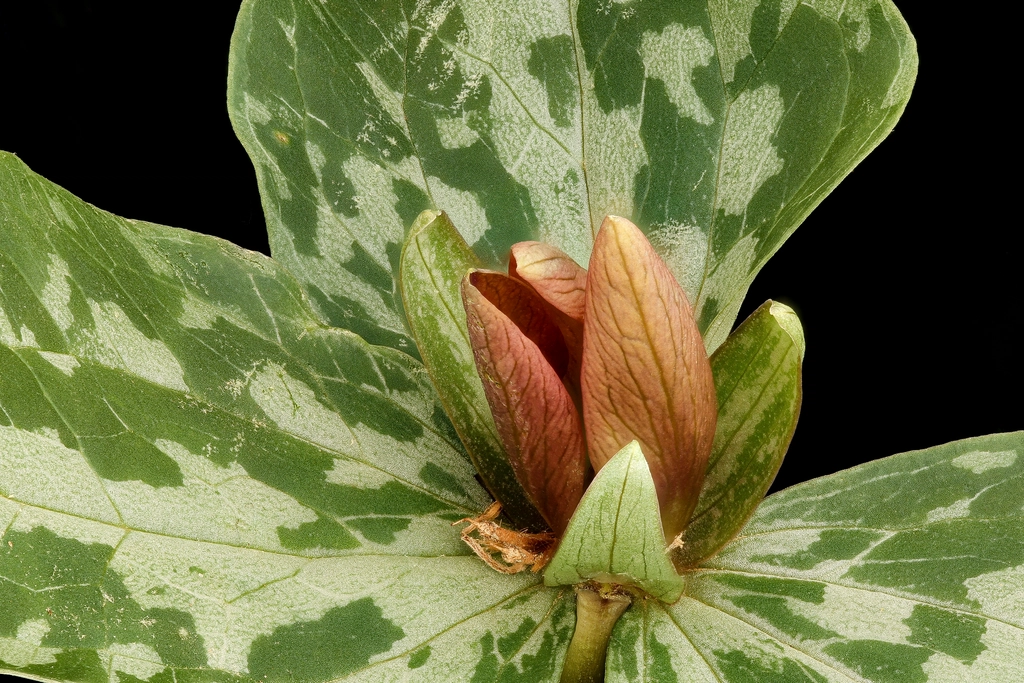
Trilliums are what guests ask about, and this region has an unusual number of species. Sweet Betsy sits its maroon flower directly on mottled leaves. Catesby’s trillium nods pink and white below the foliage. Vasey’s is big, deep maroon and sweet-smelling. Painted trillium, white with a crimson blaze, prefers cooler acid ground higher up. Large-flowered trillium makes the white sheets people photograph. Behind them come showy orchis, lady’s slipper orchids, wild geranium and foamflower.
Elevation Turns One Bloom Into Six Weeks of Bloom
In flat country, wildflower season is a date. Here it is a line that climbs the mountain. An old naturalist’s rule of thumb, Hopkins’ bioclimatic law, puts the delay at roughly four days per hundred feet of elevation gained. Treat it as a rough guide; aspect and weather scramble it.
If bloodroot has finished in the valley, it may be at peak two thousand feet above you. A warm south-facing bank runs well ahead of a cool north-facing cove at the same elevation. Missed something down low? Walk up. Came too early? Walk down.
Where to Look Around the Cabin
Ephemerals want deep, moist, rich soil with plenty of leaf mold, and they concentrate. Look in coves and hollows where the slope is concave and soil has collected, on lower north- and east-facing slopes, on benches above creeks, and around seeps. Old logging grades and streamside flats are often excellent. Dry, thin, south-facing ridge soils are generally poor for ephemerals, though they carry their own flora.
History matters too. Ground pastured or plowed within living memory usually has a thinner ephemeral flora than ground that stayed wooded, because many of these plants spread very slowly. Several are moved mainly by ants, which carry seed a few feet at a time for the oily attachment on the seed coat. The colony you are standing in may be older than the cabin by a wide margin.
Why Picking and Digging Does Real Harm
The Trillium Problem
A trillium is the clearest case. The three broad green structures below the flower sit on the same stalk as the bloom. Pick the flower and you take the plant’s entire photosynthetic surface for the year with it. The rhizome may survive, but it can be set back badly and may skip flowering for seasons. Trilliums are slow from seed as well, taking years and in many species close to a decade to reach flowering size.
Digging Is Worse
Wild-dug plants seldom survive transplanting into a suburban yard, because they depend on the soil chemistry, moisture and fungal partners of the cove. There is a real commercial dig trade here for ginseng, galax, ramps and orchids, and it has visibly emptied some slopes.
Rules differ by land manager and change over time. Collecting plants is generally prohibited in national parks; national forests may allow limited personal-use collection of certain species by permit; some states protect particular species outright; private land is the owner’s call. Ginseng specifically is regulated with defined seasons and licensing in these states. Do not go by this article or by what somebody’s uncle used to do. Check the current rule for the exact tract you are standing on. Around this cabin the answer is simple: look, photograph, leave it in the ground.
The Pressures They Are Already Under
Even with no picking at all, these plants face trouble. White-tailed deer at high density browse trilliums and orchids hard enough that botanists use trillium height as a rough index of deer pressure. Feral hogs root up entire wildflower beds in parts of the region. Garlic mustard and other invasives displace native ground flora and appear to interfere with the soil fungi natives rely on. An early warm spell followed by a hard freeze can flatten a season. All of that sits on top of the slow squeeze on cool, moist, high-elevation habitat.
How to Walk Through a Wildflower Spring
- Stay on the tread. Most damage to an ephemeral patch is done by feet, not hands. Stepping off for a photograph compacts soil and crushes plants that have not emerged yet. Shoot from the trail and get low rather than closer.
- Go early and go often. Because the display climbs, the same short walk done three weekends running shows you three different sets of flowers. One well-timed visit is luck; three visits is a season.
- Learn five plants, not fifty. Bloodroot, trout lily, one trillium, a violet and mayapple cover most of what you will see and give you a frame for the rest.
- Keep the dog leashed and on the trail. A loose dog cuts corners through exactly the wet, rich ground where the best colonies grow, and does it over and over.
- Do not move plants, seeds or soil. If you want these species at home, buy nursery-propagated stock from a grower who will say plainly that it was not wild-collected.
The best argument for leaving these flowers alone is not the rule book. The whole point of a spring cove is abundance, and abundance is the first thing picking destroys. Come up in April and walk slowly.