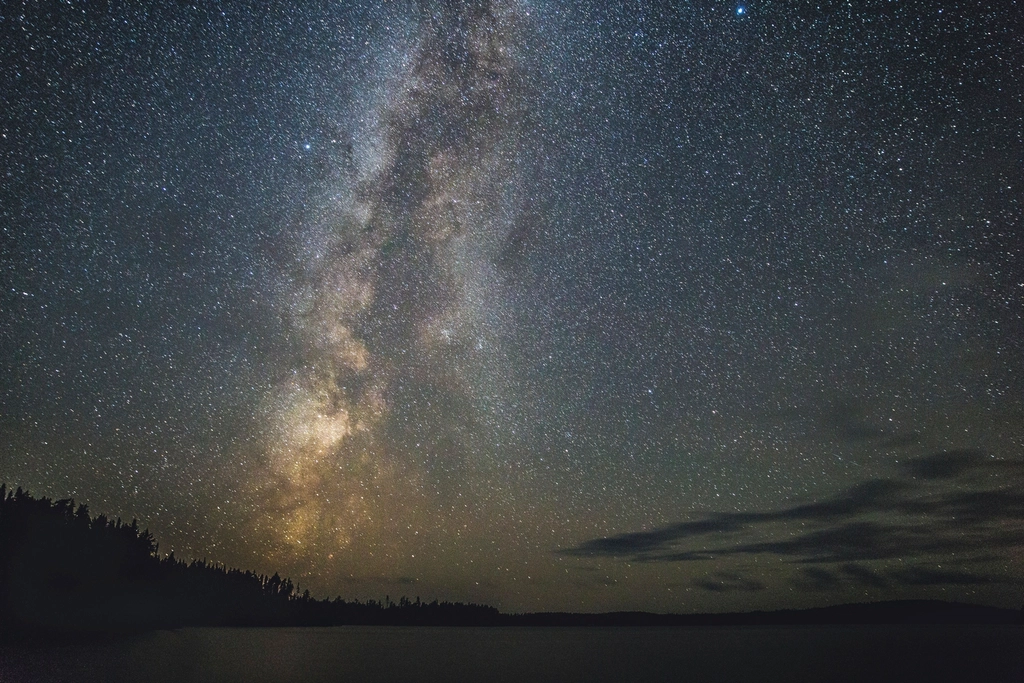
The Sky the Cove Gives Back
The first thing most visitors notice after dark at a mountain cabin is not the cold or the quiet. It is that the sky has texture. In town, the night is a flat gray lid with a dozen bright points punched through it. Up in a wooded cove, with the nearest streetlight a ridge away, the sky acquires depth — layers of stars at different brightnesses, the faint milky band of our own galaxy, and a darkness between the stars that is genuinely black rather than orange.
That difference is worth protecting and worth using. Stargazing from a cabin does not require a telescope, an app subscription, or any prior knowledge. It requires warm clothes, a bit of patience, and a willingness to sit still outdoors longer than feels natural at first. This is a practical guide to doing it well from a wooded property, where the trees, the ridges, and the mountain weather all shape what you can actually see.
Understanding What Makes a Sky Dark
Sky darkness has two components: how much artificial light reaches your location, and how much natural light is in the sky at that moment. The second one changes far more than people expect.
- The moon is the biggest variable. A full moon washes out the sky almost as thoroughly as a small town does. The week around new moon is the prime window each month, and a waning moon that rises after midnight gives you several good early-evening hours.
- Humidity scatters light. A muggy August night in the southern mountains will look hazier than a crisp November one, even with identical light pollution. Cold, dry air after a front passes is the clearest air you will get.
- Ridges are your friends. A cove that blocks the horizon toward the nearest town is trading away some sky for a much darker remainder. Learn which direction your worst glow comes from and simply plan to look the other way.
- Your own porch light is the enemy you control. A single unshielded bulb near the cabin does more damage to your night vision than a distant city. Switch it off half an hour before you go out.
Dark Adaptation Is Not Optional
Human eyes take roughly twenty to thirty minutes to reach usable night sensitivity, and a couple of seconds of white light resets much of that progress. Use a red light — a headlamp with a red mode, or plain red tape over a flashlight lens — and keep phone screens face down. The difference between a five-minute glance and a forty-minute sit is not incremental; it is the difference between seeing forty stars and seeing four hundred.
Set Up Before the Light Goes
Everything is harder in the dark, and mountain cabins add uneven ground, roots, and firewood stacks. Do the logistics at dusk.
- Pick your clearing in daylight. Walk the property and find where the canopy actually opens. A driveway turnaround, a meadow edge, or a dock often beats the deck, which is usually roofed on the side you want.
- Lay flat, not seated. A reclining chair, a cot, or a pad on the ground makes an hour of looking up comfortable instead of a neck injury. Sitting upright is why most people quit after ten minutes.
- Dress for two hours of stillness. Standing motionless outdoors is colder than hiking by a wide margin. Layer as though it were fifteen degrees colder than the thermometer says, and add a hat and a blanket even in summer.
- Stage everything on one surface. A small table or upturned crate for binoculars, a chart, a thermos, and the red light keeps you from crawling around after dropped gear.
Binoculars Beat a Beginner Telescope
The most common mistake in amateur astronomy is buying a cheap telescope first. A modest pair of binoculars — something in the range of seven to ten times magnification with reasonably large lenses — will show you more, more easily, in the first year than a department-store telescope ever will. They are quick to deploy, they show a wide field so you can actually find things, and they work handheld from a reclining chair.
Through binoculars from a dark cove you can see the four bright moons of Jupiter changing position night to night, craters along the terminator of a half moon, dense star fields in the summer Milky Way, the Pleiades resolving into a scattering of blue-white points, and the faint smudge of the Andromeda Galaxy in autumn. That is a rich first year. A telescope makes sense later, once you know what you want to look at more closely.
What to Look for Season by Season
Winter
The cold months give the crispest air and the brightest constellations. Orion dominates the southern sky, with the fuzzy patch below its belt being a star-forming nebula that binoculars begin to reveal. The bright winter stars around it form a wide loop that is easy to learn in a single evening. Long nights mean you can be out at eight and still have hours of full darkness.
Spring
Spring skies are quieter and point away from our galaxy’s crowded plane, which means fewer bright stars but a window toward distant galaxies. The Big Dipper rides high, and its handle curves down toward two bright stars that make a reliable orientation trick for the whole season.
Summer
Summer is Milky Way season in the Appalachians. Once the sky is fully dark, the galactic band arches from the southern horizon overhead, at its densest and most textured toward the south. Warm nights make long sessions comfortable, at the cost of haze and mosquitoes.
Autumn
Autumn brings back dry, clear air along with the Andromeda Galaxy high overhead, the great square of Pegasus as an easy landmark, and the year’s most reliable meteor showers building toward winter. For many cabin owners, October and November are the best all-around stargazing weeks of the year.
Meteors, Satellites and the Occasional Surprise
Meteor showers are the easiest spectacular event to plan around because their dates repeat annually. The two most dependable are in mid-August and mid-December, with several smaller showers scattered through the year. Watching one well means no binoculars at all: lie flat, take in as much sky as possible, and give it at least an hour. Rates are almost always highest in the hours after midnight, when your side of the planet has turned to face the incoming debris.
- Do not look at the radiant. Meteors appear to originate from one constellation but streak across the whole sky. Looking a good distance away from that point gives you longer, more dramatic trails.
- Satellites are constant now. Slow, steady points crossing the sky without blinking are satellites; the blinking ones are aircraft. Trains of them shortly after dusk are recently launched clusters, and they are common enough that visitors should be warned in advance.
- The zodiacal light is a real thing. In very dark skies in early spring and late autumn, a faint cone of light along the horizon after twilight is sunlight scattering off dust in the solar system. A wooded cove with a low horizon in the right direction can show it.
- Aurora is rare here but not impossible. During strong solar storms, faint red glow low on the northern horizon has been reported from Appalachian latitudes. A dark north-facing clearing is the only way you would ever notice.
Learning the Sky Without Screens
Phone apps that overlay constellation names are genuinely helpful and genuinely corrosive to learning, because the screen ruins your dark adaptation and does the work your memory should be doing. A middle path works well: use the app indoors before you go out to see what will be up, then take a printed planisphere or a monthly chart outside with a red light.
Learn in landmarks rather than lists. Find one obvious pattern — the Dipper, Orion, the summer triangle of three bright stars overhead in July — and use it to point to two or three neighbors. Do that for a few nights and the sky stops being random. Within a season, you will step outside to bring in firewood, glance up, and know roughly what time it is from the position of what you see.
Keeping the Cove Dark
Dark sky is a shared resource, and cabin properties are unusually good at either preserving or destroying it. Outdoor lighting that points downward, uses warm color temperatures, and switches on only when needed does almost everything a floodlight does without erasing the sky for you and your neighbors. Motion sensors are better than dusk-to-dawn timers. Shielded fixtures put light on the steps where you need it rather than into the canopy.
There is a practical dividend too: wildlife, insects, and your own sleep all do better under less artificial light. Guests who arrive expecting a floodlit yard often leave asking why their own street cannot look like this.
An Evening Worth Repeating
The best stargazing nights at a cabin tend to follow the same shape. Supper early. Porch light off before dusk. A chair carried out to the clearing while there is still enough light to see the ground. Warm layers on before you feel cold rather than after. Then forty minutes of doing very little, while the sky slowly fills in and the woods carry on with their own night business around you.
You do not have to identify anything for it to be worth the hour. But if you keep at it across a year, the sky becomes a place with directions and seasons and familiar corners, the same way a trail network does. That is the quiet reward of a dark cove: it gives you a second landscape, directly overhead, that most people never get to know.