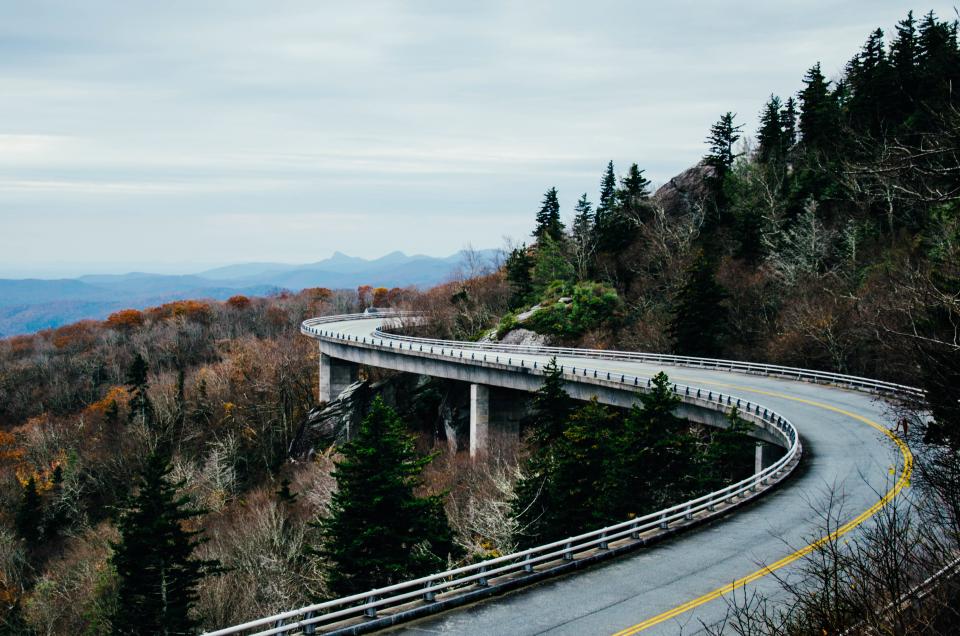
The Road Is Part of the Trip
Guests tell us the same thing when they step out onto the gravel: the last four miles took longer than the forty before them. A mountain road in this part of the Appalachians is not a slower version of a highway. It is a different kind of road with different rules.
These ridges are old. They were folded up hundreds of millions of years ago and have been eroding ever since, which is why the slopes are steep but rounded rather than jagged. Water has had a very long time to cut coves and hollows into them, and roads follow what the water left: creek bottoms, a climb up a side slope, then switchbacks to gain the ridge. Nobody surveyed a straight line up here because there was never a straight line available.
Grade, Switchbacks and Your Brakes
What surprises flatland drivers is not the curves but the sustained grade. A road can climb two or three miles without a level stretch, and on the way back down that grade will quietly cook your brakes if you ride them the whole way.
The fix is old-fashioned: descend in a lower gear. Put an automatic in a manual mode or low range and let the engine hold you back, using the brakes in firm intermittent applications rather than constant pressure. If you smell something hot and acrid on a descent, pull off and let everything cool. Brake fade is not a dramatic failure; it is a gradual softening of the pedal you notice at exactly the wrong moment.
Reading a switchback before you are in it
Switchbacks here are often tighter than the approach suggests, and frequently off-camber, meaning the surface tips away from the turn instead of into it. Slow before the turn rather than in it, and look through the corner. Expect the inside of a tight switchback to be the roughest part of the road, because that is where every vehicle that ever climbed it spun a wheel.
Uphill has the right of way
The old mountain convention, echoed in most state driver handbooks, is that the vehicle going downhill yields, because the uphill driver may lose momentum on a steep pitch. In practice, whoever is closer to a pull-off backs to it, and a raised hand is the whole negotiation.
Gravel, Washboard and Mud
Our last stretch is gravel, which most people have driven and almost nobody has driven on a grade. Gravel worsens two things: stopping distance and steering authority. Do everything earlier and more gently than on pavement, and expect ruts after a hard rain, when a thunderstorm can cut a channel clean across a grade overnight.
- Slow down for washboard, do not speed up. There is a persistent myth that above a certain speed you float across the ripples. What actually happens is that your tires spend part of the time in the air, which means part of the time with no steering and no braking.
- Stay off the loose outside edge. The shoulder of a gravel mountain road is often built-up fill rather than solid ground, and it goes soft after rain. Drive the compacted wheel tracks when nothing is coming, and move over deliberately when something is.
- Brake in a straight line. Combining hard braking with steering on gravel is how a car ends up sideways. Get your speed off before the curve, then steer.
What a Rental Car Can and Cannot Do
We are asked constantly whether a guest needs four-wheel drive. The honest answer depends on the season and that week’s weather, so ask us for current conditions rather than trusting a blanket answer.
In dry weather from late spring through fall, an ordinary front-wheel-drive sedan gets up our road fine if driven sensibly. What limits it is usually not traction but ground clearance. A low front air dam meets the crown of a gravel road, a waterbar, or the lip where gravel meets pavement, and something plastic tears loose. Low-slung sedans and EVs are the usual casualties.
When drive actually matters
Traction becomes the limiting factor on wet clay, snow or ice. Our soils are heavy in clay, and wet clay on a grade is slick in a way wet gravel is not. In winter, all-wheel drive on proper tires is a real advantage getting up, but understand the asymmetry: it helps you go and does almost nothing to help you stop.
The fine print
Many rental contracts exclude damage from unpaved roads, and some prohibit them outright. Know what you signed before assuming a scraped underbody is covered. For a mountain trip, a small crossover rather than the cheapest compact is money well spent on clearance.
Meeting Somebody on a One-Lane Stretch
There are places on our road where two vehicles cannot pass. Locals handle it without ceremony.
- Assume something is coming around every blind curve. Drive at a speed that lets you stop within the distance you can actually see, which on a tight inside curve may be two car lengths.
- Learn the pull-offs on your first trip up. After one round trip you will know the three or four wide spots, and that knowledge is what lets you back up confidently instead of hesitantly.
- Back up rather than argue. Whoever has the shorter distance to a pull-off goes back. A pickup with a trailer cannot reverse a switchback safely, so if you meet one, you are the one moving.
- Give working vehicles priority. Log trucks, propane trucks, septic pumpers and line crews are heavy and cannot stop the way you can. Yield early and give them the inside line.
Fog in the Gaps
These mountains make their own weather, and fog is its most reliable expression. Moist air pushed up a slope cools and condenses, so cloud forms right against the ridge. You will drive through a band of it, come out into sunshine, and drive into another at the next gap. Valley fog works the other way, pooling in the cove overnight and burning off by mid-morning.
Handling it is undramatic. Use low beams; high beams reflect off the droplets and make things worse. Slow to a speed where you could stop within the distance your headlights actually reach, which in thick fog is startlingly short. Crack a window so you can hear an engine you cannot yet see, and never stop in a travel lane. In cold months, a fog bank sitting on a shaded curve is exactly where black ice forms first.
Closures Worth Respecting
Gates and closure signs on mountain roads are not suggestions. Higher-elevation roads here, including sections of the Blue Ridge Parkway and roads inside the national park and national forests, close seasonally and on short notice for snow, ice, rockslides, downed trees and washouts. Closure dates are not fixed by calendar; they depend on conditions, and a road open in the morning can be gated by afternoon. Check the managing agency’s current road status before planning a route over a high gap. Policies differ between the Parkway, park service roads, forest service roads and county roads, so check the specific road rather than assuming one rule covers all.
People go around gates because it looks fine from the gate. The hazard is rarely there. It is two miles up on a shaded curve, or a slide that took out half the roadbed where nobody can see it from below. Cell service on those roads is unreliable, turning around may be impossible, and recovery is dangerous for whoever comes to get you. Driving around a closure is also a citable offense in most jurisdictions here.
Arriving Without Drama
A few habits make the drive easy. Fill the tank in the last real town rather than assuming there is a station closer; there often is not. Download your map for offline use before you leave pavement, because navigation apps lose service and will route you onto a forest road nobody has maintained in a decade. Give yourself daylight for the first trip up.
Then let the drive be what it is. The road climbs because the land climbs, and the reason the cabin sits where it does is the same reason getting there takes a while. By the time you shut the engine off and hear nothing but the creek, those last four miles have already done their job.