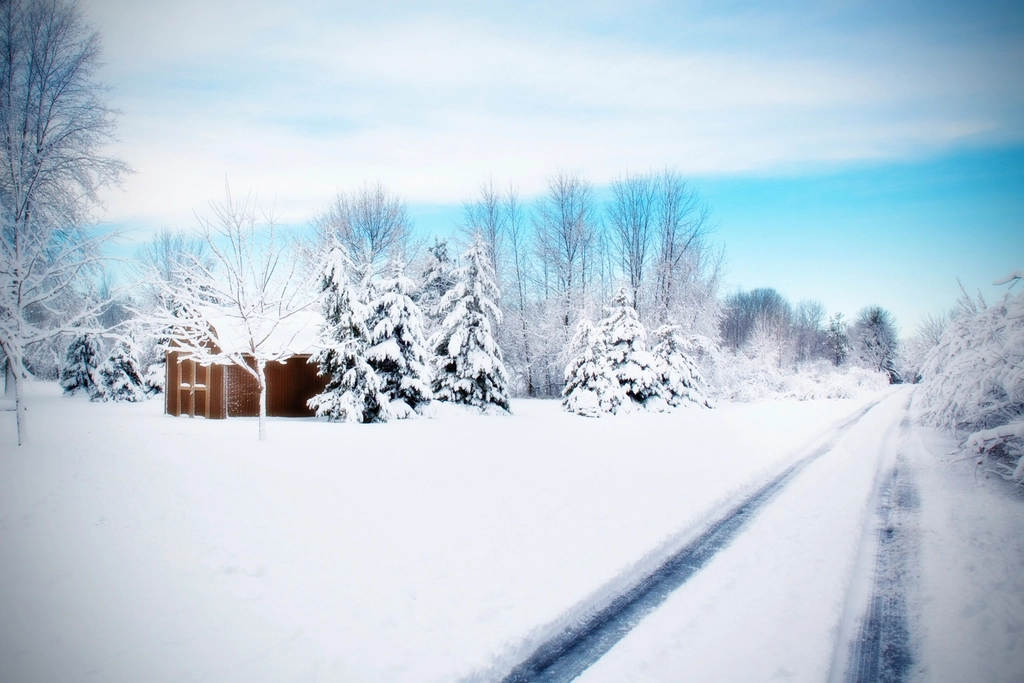
The Drive Is the Whole Problem
Ask anyone who owns a cabin at the end of a steep gravel lane what worries them about winter and the answer is never the cold, the wood supply or the pipes. It is the last quarter mile. A mountain driveway is a narrow, unpaved, often unmaintained road with grade, curves, side slope and a creek somewhere at the bottom of the fall line, and it turns from a mild inconvenience into a genuine hazard the first time a warm afternoon melts the snow and a clear night freezes it into a luge run.
Winter access in the Appalachians is not principally a snow problem. Snowfall totals here are usually modest by northern standards. It is an ice problem, created by a climate that swings above and below freezing repeatedly within a single week. That distinction should shape every decision you make about tires, tools, timing and the driveway itself.
Understand What You Are Actually Driving On
The freeze-thaw cycle is the defining feature of an Appalachian winter. A ten-inch snowfall on a Tuesday might reach fifty degrees Fahrenheit on Thursday, then drop into the teens overnight. What that produces is not soft snow but a dense, polished, refrozen crust with meltwater underneath it. Add the shade of a north-facing hollow, where the sun never touches the road all winter, and you get patches that stay solid ice for weeks after everything else has cleared.
- Shaded curves stay frozen longest. The steep, north-facing bend that is perfectly fine in every other season is the piece of road that will hold ice into March. Learn where those spots are on your own drive and treat them as permanently suspect.
- Mud season is the other half of the problem. When the ground thaws from the top down while a frozen layer remains below, water cannot drain away and gravel roads turn to soup. A drive that carried a loaded truck in January can swallow it in March.
- Black ice forms first on bridges and stream crossings. Air circulating underneath cools the surface from both sides. Any culvert crossing or low water bridge on your lane freezes before the road around it does.
- The steepest section is rarely the worst. The dangerous places are the transitions: where a steep pitch meets a curve, or where the cross-slope tips you toward the downhill edge.
Preparing the Driveway Before Winter
Most winter access problems are drainage problems in disguise. Water that leaves the road surface cannot freeze on it, and the fall is when you fix that cheaply.
- Clean every culvert and ditch. Leaves and washed gravel plug culverts in autumn, and a blocked culvert sends the stream across your road, where it freezes into a sheet. This is the single highest-value hour of work you will do all year.
- Restore the crown and the water bars. A road surface should shed water to the sides. Grading a slight crown and installing or clearing diagonal water bars or broad rolling dips on the steep sections keeps runoff from running down the wheel tracks and gullying the whole lane.
- Top up with the right gravel. Crusher run or dense-graded aggregate with fines packs down and holds together. Round river gravel rolls under tires and gives no traction at all on a grade. Concentrate new material on the steep pitches.
- Cut back the brush and the low limbs. Snow-loaded branches bow into the roadway and will stop a plow truck or scrape a vehicle. Clear a wider corridor than you think you need, and open the sunniest edges so shaded ice gets some help.
- Mark the edges now. Drive fiberglass or wooden stakes with reflective tape along the shoulders, especially at drop-offs, culvert headwalls and the turnaround. Under snow the edge of a mountain drive is invisible, and going off it is how vehicles end up in the creek.
- Build a turnaround or a bail-out. A flat widened area partway up, where a vehicle can turn or wait, is worth more than any accessory you can buy. Backing down an icy mountain lane at night is how people get hurt.
The Vehicle and the Tires
There is a persistent belief that four-wheel drive solves winter. It does not. Four-wheel drive helps you accelerate. It does essentially nothing for braking or steering, which are the two things that fail on a descent. Plenty of cabin owners have driven confidently uphill in an all-wheel-drive vehicle and then discovered on the way back down that they had no way to stop.
Tires do the real work
Winter tires, with a rubber compound that stays flexible below about forty-five degrees Fahrenheit and a tread designed to bite, outperform all-season tires on a four-wheel-drive vehicle by a wide margin. Look for the three-peak mountain snowflake symbol on the sidewall, which certifies severe snow service; the M+S marking alone does not mean much. On a steep gravel drive, a set of four winter tires on a two-wheel-drive truck will usually beat all-seasons on anything.
- Carry chains and know how to fit them. Practice once in the dry, in daylight, on a level surface. Fitting chains for the first time at night, in sleet, on a grade, with cold hands, is miserable and often unsuccessful.
- Add weight over the drive wheels. Sandbags or tube sand over the rear axle of a pickup transforms its behavior, and the sand itself becomes traction material when you need some.
- Descend in low range and low gear. Let engine braking hold the vehicle back. Riding the brakes on ice locks the wheels and turns steering into a polite suggestion.
- Keep the fuel tank above half. It prevents condensation in the tank and, more importantly, gives you hours of heat if you end up waiting for help.
Clearing Snow on a Grade
How you clear matters more than how fast. The goal is to remove snow before it gets compacted and before it melts and refreezes into something no blade can lift.
- Plow early and plow often. Two passes during a storm are far easier than one pass afterward. Once traffic packs snow into a glazed layer, no plow will take it up and you are committed to sand for the rest of the season.
- Leave an inch on gravel. Setting the blade to skim just above the surface, or using skid shoes, keeps you from scraping your gravel into the ditch. Rebuilding a scalped drive every spring is expensive.
- Push snow to the downhill side and away from curves. Banks on the uphill side melt across the road and refreeze there. Piles at a bend narrow the very place you need the most room.
- Do not pile snow where it blocks the ditch or the culvert. The meltwater has to have somewhere to go, and if it does not it will find your wheel tracks.
- Consider hiring it out. A local contractor with a truck who already runs your road may cost less annually than owning, storing and maintaining a plow or a tractor with a blower, and they will show up at four in the morning.
Traction material versus salt
On a gravel mountain drive, abrasives usually beat chemicals. Coarse sand, crushed stone screenings, or wood ash from the stove provide instant grip and do not corrode vehicles or damage roadside soil and the stream below. Rock salt loses effectiveness below about fifteen degrees Fahrenheit, runs off into whatever watercourse your drive drains toward, and is hard on concrete, culverts and vegetation. Calcium chloride works to much lower temperatures and is worth keeping for a small critical patch — the steps, a walkway, one shaded curve — rather than treating the whole lane. Keep a bucket of sand and a scoop in the vehicle, and another by the cabin door.
Walking In
Sometimes the correct decision is to leave the vehicle at the bottom. Experienced cabin owners plan for this rather than treating it as a failure, and a good winter setup makes the walk unremarkable.
- Keep a parking spot at the road. A place at or near the paved county road where you can legally leave a vehicle without blocking a plow is the foundation of the whole plan.
- Own traction devices for your boots. Strap-on spikes or chains for footwear cost very little and make an icy grade genuinely walkable. They are the highest-return winter purchase for a cabin, by a distance.
- Get a sled. A plastic utility sled hauls groceries, water jugs, propane bottles and firewood up a snowy lane far more easily than carrying them, and it doubles as an emergency stretcher.
- Carry a headlamp and layers, always. Winter dark arrives by five. A twenty-minute walk becomes a serious situation if you turn an ankle without a light and a warm layer.
- Snowshoes for the deep years. In a heavy snow winter, a pair kept at the bottom parking spot turns an exhausting slog into a pleasant walk.
Provisioning So Access Is Optional
The best answer to a bad week on the road is not needing the road. A cabin stocked to sit out five days removes almost all of the pressure that makes people drive when they should not.
- Top off propane and fuel before the first hard weather. Delivery trucks cannot climb what a pickup cannot climb, and the peak-season call queue is long. Order early, not when the tank gauge reads twenty percent.
- Keep firewood staged close. A week or two of split wood on a covered porch means you are never hauling from a buried stack in the middle of a storm.
- Store water for a freeze or an outage. Pumps stop without power and lines freeze. Jugs kept in a heated space and a filled bathtub before a storm cover flushing and drinking.
- Plan for a power cut. Batteries, lamps, a charged power bank, a battery or crank radio, and a stove you can cook on without electricity. Never run a generator, grill or unvented fuel heater indoors or in a crawlspace.
- Know your communication situation. Cell coverage is patchy in the hollows. Learn where the one bar lives, and tell somebody your plans and expected return before you head up.
The Judgment Call
Every winter, somewhere in these mountains, someone tries the drive one more time because they are almost home. The vehicle slides, catches the soft shoulder, and ends up on its side in the laurel. Nobody plans that; it comes out of a single optimistic decision made at the bottom of the hill at nine at night.
Set your rules while you are warm and dry. If freezing rain is in the forecast, arrive before it or do not arrive. If the surface is glazed and shining rather than white, park at the road and walk. If you can hear the tires slipping on the first pitch, the rest of the lane will be worse, not better. Turn around while there is still somewhere to turn around.
Handled with a little forethought, winter is the best season a mountain cabin has. The forest opens up, the ridgelines become visible through bare trees, the creek runs loud under a skim of ice, and the woodstove earns everything you spent on it. The road is simply the price of admission, and it is a manageable price for anyone willing to clean a culvert in October and keep a bucket of sand by the door.