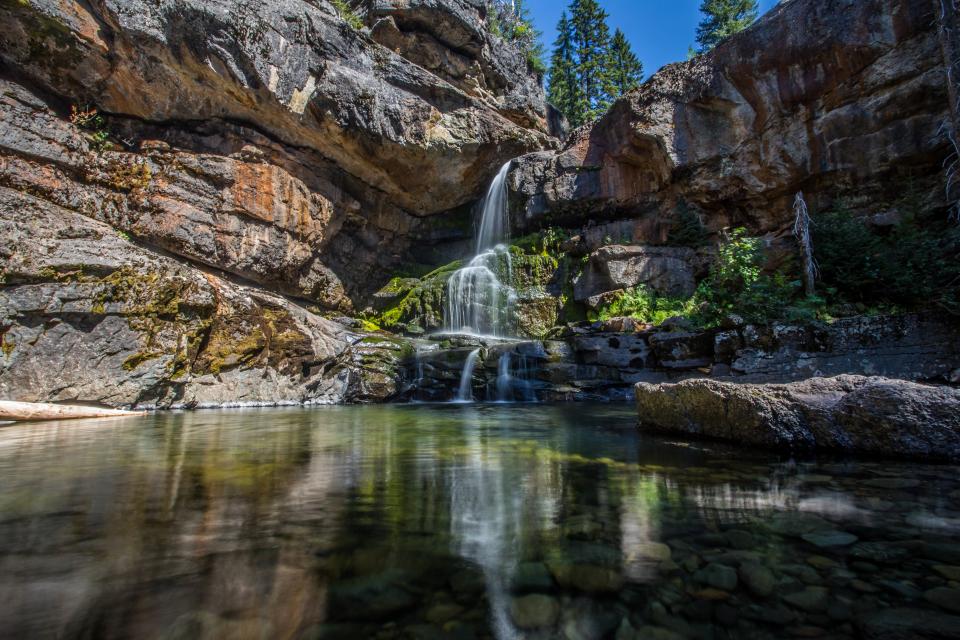
Small Water, Serious Fish
The creek below the cabin is not much to look at. In most places you could step across it. That modesty is the point. Southern Appalachian trout streams are small, cold, shaded and steep, and the fishing they offer has little in common with the wide western rivers people picture when they hear the word trout.
What makes these streams work is the terrain. Steep gradient means fast, oxygenated water. Dense hardwood and rhododendron cover keeps summer temperatures down. Springs and seeps feed the headwaters year-round. Put those together and you get cold water at surprisingly low elevations, which is why trout persist this far south at all.
Stocked Water and Wild Water
The first thing worth understanding is that not all trout water here is the same kind of trout water, and the difference shapes everything from where you go to what you are allowed to do.
What stocking means
State agencies raise trout in hatcheries and release them into designated streams, usually where access is easy and public interest is high. Stocked fish are typically rainbows, sometimes browns, occasionally brook trout. They are naive at first, they concentrate near the stocking point, and they tend to get caught quickly. Some hold over and become wary; many do not survive a hot summer in marginal water.
There is nothing wrong with fishing stocked water. It is where most people catch their first trout, and it takes pressure off fragile wild streams. Just know what you are fishing.
Recognizing wild water
Wild trout are stream-born and stream-raised. They live in headwaters, above waterfalls and culverts, in stretches nobody drives to. You will notice the difference immediately: the fish are smaller, better colored, harder to approach, and they come out of pockets you would have walked past. A wild eight-inch trout in a plunge pool is a genuinely impressive animal that has survived floods, droughts and every heron on the creek.
Brook Trout and Why They Matter
The brook trout is the only trout native to these mountains, and strictly speaking it is not a trout at all but a char, closely related to lake trout and Arctic char. Rainbows came from the West Coast and browns from Europe, both introduced generations ago and now thoroughly established.
Southern Appalachian brook trout, the fish old-timers call specks, sit at the far southern edge of the species range. They have been pushed steadily upstream for more than a century by logging that stripped the shade off streams, by acid deposition, by warming water and by competition from introduced rainbows. What remains are isolated populations in cold headwaters, often above a barrier that keeps other fish from moving up.
That isolation is the whole story. Each surviving population is a small, genetically distinct pocket with nowhere to retreat if its stream goes bad. Restoration work in the region focuses on protecting those headwaters and, in places, removing nonnative fish above barriers so brook trout can be returned. When you catch one, you are handling a fish whose ancestors have been in that drainage since the last ice age.
Licenses and Rules Change With the Water
This is the part guests most often get wrong, because they assume a fishing license works like a driver license.
- The license is by state, not by region. North Carolina and Tennessee sell separate licenses, and many trout waters require a trout privilege or stamp in addition to the basic license. Buy online or at a local outfitter before you fish, and carry proof.
- National park waters have their own regulations. Streams inside Great Smoky Mountains National Park are managed under park rules that differ from the surrounding state rules, including restrictions on tackle and bait. Read the park’s current fishing page before you go.
- Streams are classified, and classifications differ. States designate trout water into categories such as hatchery-supported, delayed harvest, wild trout and catch-and-release with artificial lures only. Each has its own season, tackle rules and creel limits, and the classification can change at a bridge.
- Seasons and closures move. Some hatchery-supported water is closed for part of the spring, some delayed-harvest water changes rules on a set date, and emergency closures happen after fish kills or drought. Do not rely on last year’s information.
- Read the sign at the access point. Agencies post the classification, the season and the limits right where you park. That posted sign, plus the current regulations digest, is the authority. Nothing in this article is.
The short version: check the current rule for the specific water on the day you fish. We keep a digest at the cabin, but it goes out of date, so confirm online.
Reading a Small Stream
Trout in small water need three things at once: cover, oxygen and a place where food drifts by. Learn to see where those overlap and you stop casting at random.
The features that hold fish
Plunge pools below small falls are the obvious ones, and the head of the pool where white water meets the calm is usually the best lie. Behind a boulder is a slack pocket where a fish holds with little effort while the current delivers food past its nose. Undercut banks, root wads and the shade line under a rhododendron thicket all hold fish, often in a foot of water. Seams, where fast and slow water run side by side, deserve more attention than the fast water itself.
Approach is most of the game
In clear, shallow water the fish know you are there long before you cast. Fish upstream so you approach from behind them, since trout face into the current. Stay low, use streamside vegetation to break your outline, and never throw a shadow across a pool. Most missed fish here were spooked, not refused.
Tackle that fits
Short rods win in tight cover. A seven-foot or shorter fly rod in a light line weight, or a compact spinning outfit, handles rhododendron tunnels far better than the long rod that works on a big river. Attractor dry flies, small nymphs and tiny spinners all catch fish. Precision beats distance; most casts are shorter than the rod is long.
Handling Fish You Intend to Release
Catch and release only works if the fish lives. Most damage happens in the thirty seconds after landing.
- Pinch the barbs down. Barbless hooks come out faster and do less tearing, and on many waters here they are required rather than optional.
- Keep the fish wet. Unhook it in the water when you can. Air exposure stresses trout quickly, and a fish held up for a photo sequence is a fish with poor odds.
- Wet your hands first. Dry hands and dry surfaces strip the protective slime coat that guards against infection. Never grip a trout hard or hold it by the gills.
- Use a rubber net. Soft rubber mesh does far less damage than knotted nylon and does not tangle hooks or fins.
- Revive before letting go. Hold the fish upright facing the current until it holds itself and swims off under its own power. Do not push it back and forth.
- Rest the stream when it warms. Trout are already stressed in warm water, and a fish released in the upper sixties Fahrenheit may not survive the fight. Fish early mornings in midsummer, or find higher, colder water.
Fishing Like Someone Who Lives Here
A few habits separate visitors who are welcome back from those who are not. Know whose land you are standing on; a stream running through private property does not carry public access with it, and asking first is both courteous and the law. Clean and dry your waders and boots between drainages, because invasive algae and pathogens travel on wet gear, and check whether the state restricts felt-soled boots, since some do. Pack out every scrap of tippet. Give other anglers room, entering the water well above or below them.
Above all, go slowly. These streams reward the person who fishes fifty yards thoroughly over the one who covers a mile. Sit on a rock and watch the water before you string a rod. You will see where fish are rising, where the current stacks the drift, and how a mayfly comes off the surface film. That watching is half of what makes mountain fishing worth doing, and it costs nothing but the willingness to be still.