You Are Standing in a World Capital of Something
Guests come for the views, the creek and the porch. Very few arrive knowing that the ground under the cabin is one of the most important places on the planet for an entire branch of vertebrate life. The southern Appalachians hold more kinds of salamanders than anywhere else on Earth, and Great Smoky Mountains National Park is regularly called the salamander capital of the world, with roughly thirty species inside its boundary.
That is not a marketing line. It is a genuine global distinction, and it sits in the wet leaf litter twenty feet off the porch steps.
Why This Particular Range
Several things line up here. These mountains are old, unglaciated and topographically complicated, so during the ice ages they served as a refuge while much of the continent was scoured. Cool, wet, high habitat sat next to warm valleys, so species shifted up and down instead of being wiped out. Then, as the climate warmed, cold-adapted populations retreated upslope and got stranded on separate summits like islands in a warm sea.
Add high rainfall, a permanent supply of seeps and spring-fed headwater streams, and deep organic soil under a rich canopy, and you get long isolation and divergence. Whole species here occupy a single massif and occur nowhere else.
Lungless, and What That Costs Them
Breathing Through Skin
Most of the salamanders here belong to the family Plethodontidae, and adults in that family have no lungs at all. They exchange gas across their skin and the lining of the mouth. That works only if the surface stays moist, which is why a lungless salamander is fundamentally a creature of damp: under a rotting log, in a seep, in the spray zone of a small falls, in the litter after rain, in the cool ground during a dry spell.
It also explains why they vanish in daylight and drought. They are not gone; they are down in the soil column waiting for humidity. Dry conditions do not inconvenience them, they shut off their breathing.
Skipping the Pond
Many woodland plethodontids also skip the aquatic stage entirely. The female lays a small clutch in a moist cavity or under a log, often guards it, and the young hatch as miniature adults with no free-swimming larva. That let them colonize whole mountainsides, and it is another reason forest floor moisture matters here.
Who You Will Actually Meet
In and Along the Creek
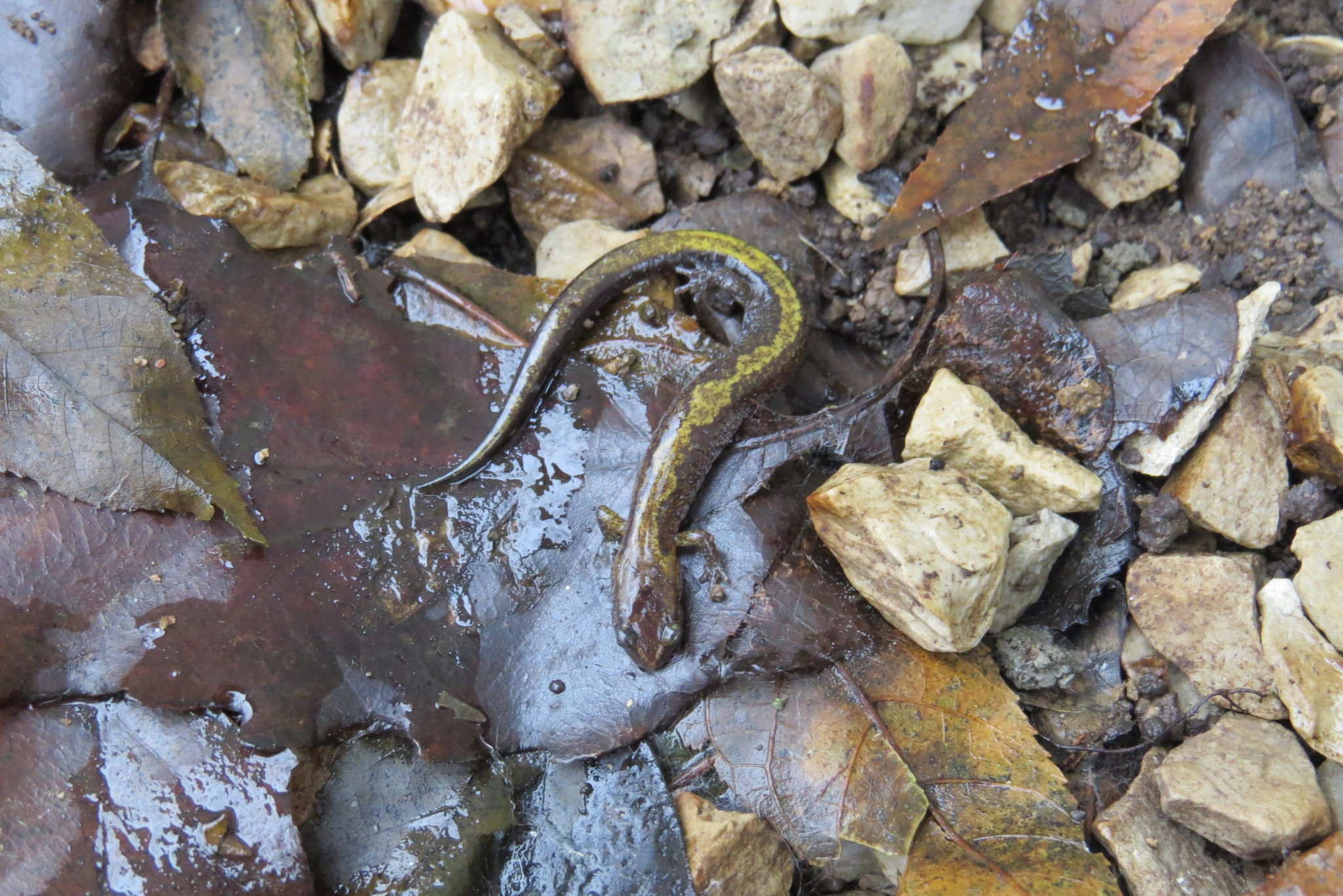
At the creek margin you will find dusky salamanders, small brown animals that bolt in a series of flips, and two-lined salamanders, slender and yellowish with a dark stripe down each side. In cold spring runs look for the spring salamander, a large salmon-colored animal with a pale line from eye to nostril, and the red salamander, bright coral with black flecks when young.
On the Slope
Away from water, the woodland Plethodon salamanders live under logs and stones. Several in this region are slate-gray with brassy or white flecking; a few high-elevation forms carry red cheeks or red legs, and some of those exist only on a handful of southern Appalachian peaks. On shaded rock outcrops, the green salamander, lichen-patterned and flat-bodied, is a regional specialty and a species of real conservation concern.
The Hellbender
The hellbender is worth going out of your way to respect. It is a fully aquatic giant, wrinkled and flat-headed, that can approach two feet long and lives its whole life in clean, cold, well-oxygenated streams under large flat rocks. Populations across its range have declined sharply, mostly from siltation and habitat disturbance. If you fish or wade, do not roll big flat rocks. Those rocks are the nest sites, and a male may be guarding eggs beneath one. Legal protections differ by state and change, so check current regulations before handling anything.
The Frog Calendar
Frogs here run on a schedule you can learn by ear in one season, and the porch is the best listening post.
Late Winter into Spring
Spring peepers open the year. On the first warm, wet evenings of late winter, a chorus of small treefrogs turns a wet flat into a wall of sleigh bells loud enough to be uncomfortable up close. Upland chorus frogs join with a sound like a thumbnail run along a comb. Wood frogs breed explosively in cold water very early, sounding like distant clucking ducks. Not long after, American toads lay in long musical trills, and the mole salamanders make their own rainy-night migration to woodland pools.
Warm Nights
As the season turns, gray treefrogs take over with a short resonant trill from the trees around the cabin. Green frogs contribute a loose banjo string plunk from the pond edge, bullfrogs the low jug of rum, and pickerel frogs a snore you will mistake for something mechanical. By late summer the chorus thins and the insects take the night over.
Sky Islands and a Warming Climate
The same history that produced this diversity makes it fragile. A cold-adapted salamander that already lives on the top of its mountain has no higher ground to move to. When the climate at that elevation gets warmer or drier, or when the reliably wet days per year decline, the habitat does not shift upslope, it simply shrinks. Researchers here have been documenting changes in body size, activity and elevation range for years, and the trend is not encouraging.
The loss of eastern hemlock to the hemlock woolly adelgid compounds it. Hemlock shaded headwater streams and held them cold. Where the hemlocks have died, streams get more light, warm up, and change character, and the animals that needed cold, stable water pay for it first.
The Other Pressures
Development is the blunt one. Road cuts, driveways, septic fields and construction on steep slopes send sediment into headwater streams, and sediment fills the spaces between stones where larvae and hellbenders live. Culverts that perch above the streambed cut populations in half. Clearing streamside forest removes the shade and the leaf input the whole system runs on.
Disease is the quieter one. The chytrid fungus that has devastated amphibians globally is present in North America, and a related fungus specific to salamanders has caused severe die-offs in Europe. As of this writing it has not been detected in wild populations in North America, and import restrictions aim to keep it out, though that can change and is worth checking. The practical point: people move pathogens on boots, nets and boats.
How to Look Without Doing Harm
- Go out after dark in the rain. A warm, wet night in spring or fall is worth ten dry afternoons. Take a headlamp, walk the creek and the wet roadbank slowly, and look at the ground rather than ahead of you.
- Put the log back the way it was. If you turn a rock or a piece of wood, roll it toward you, look, and set it back in its exact seat. That log is a house, and its damp underside took years to develop.
- Leave big flat stream rocks alone entirely. They are the hellbender rocks and the nest cover for other species, and there is no way to replace one without crushing what was underneath.
- Do not handle them if you can avoid it. Amphibian skin absorbs whatever is on your hands: sunscreen, repellent, soap and sanitizer are all harmful. If you must move one off a road, rinse your bare hands in creek water first and be quick.
- Never take one home. Collecting is regulated by state wildlife agencies, prohibited in national parks, and some species are protected. Rules differ by state and change, so check the current regulation. Even where legal, a mountain salamander does not do well in a tank.
- Clean your gear between watersheds. Rinse and dry boots, waders and nets before moving to a different stream. It costs you ten minutes and it is the single most useful thing a visitor can do about amphibian disease.
- Drive slowly on wet nights. The same rain that brings them out puts them on the road, and the gravel road up here is a breeding-season crossing.
Sit on the steps some rainy April evening with the peepers going and a light on the seep below the cabin. What is down there is not a curiosity; it is the reason biologists come here from all over the world.